FLAN-T5 Base, fine-tuned for geometry
I started from Google’s 247.5-million-parameter model and trained it to translate natural language into compact geometry actions.
AI model I’m fine-tuning · Voice and text input · Active development

Loading interactive logo…
GraphDat is my AI-backed geometry system, which I'm building as a natural-language layer over GeoGebra. I started with Google's FLAN-T5 Base model and am personally fine-tuning and evaluating it on geometry instructions. A deterministic scene engine checks and executes the model's actions so every construction stays inspectable, persistent, and editable.
Each capture stays focused on the interaction: construct, transform, or turn an image into editable polygonal geometry.
A rapid live session begins with one coordinate burst, then layers polygons, rotations, dilations, circles, color changes, visibility edits, and mirrored details while the construction remains editable.

A recorded local run produced 5,126 scene-command lines and 8,104 compiled GeoGebra commands in 80.6 seconds across the four recorded local pipeline stages.
A live model session creates an asymmetric figure, then shows recoloring, opacity, translation, rotation, dilation, and continued stateful editing.

A recorded local run produced 5,743 scene-command lines and 9,033 compiled GeoGebra commands in 85.1 seconds across the four recorded local pipeline stages.
I made many of these constructions while helping train and evaluate leading AI models over the past few years—reviewing other contributors' work and designing geometry problems that expose reasoning limits. Not every construction below is reproducible through GraphDat yet. Together, they show the spatial reasoning, symmetry, topology, and visual structure I want the software to handle over time.
A dynamic study from my broader geometry work, where repeated structure and local decisions create a visually dense global problem.
Open the live construction ↗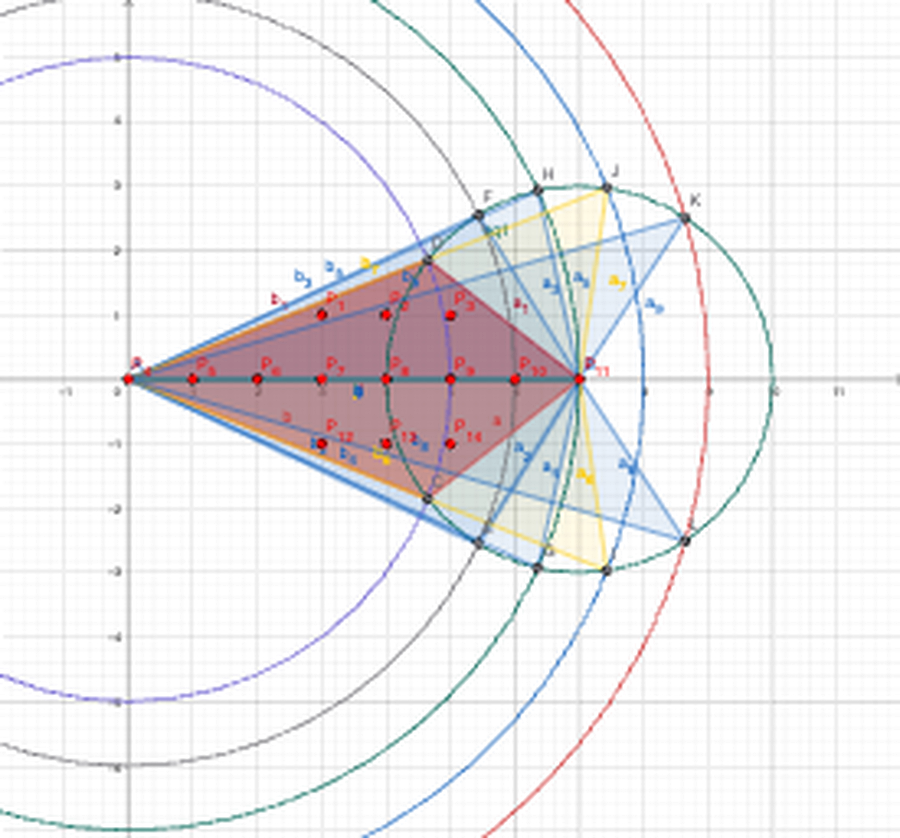
A layered construction built from concentric circles, intersections, and repeated polygons.
Open the live construction ↗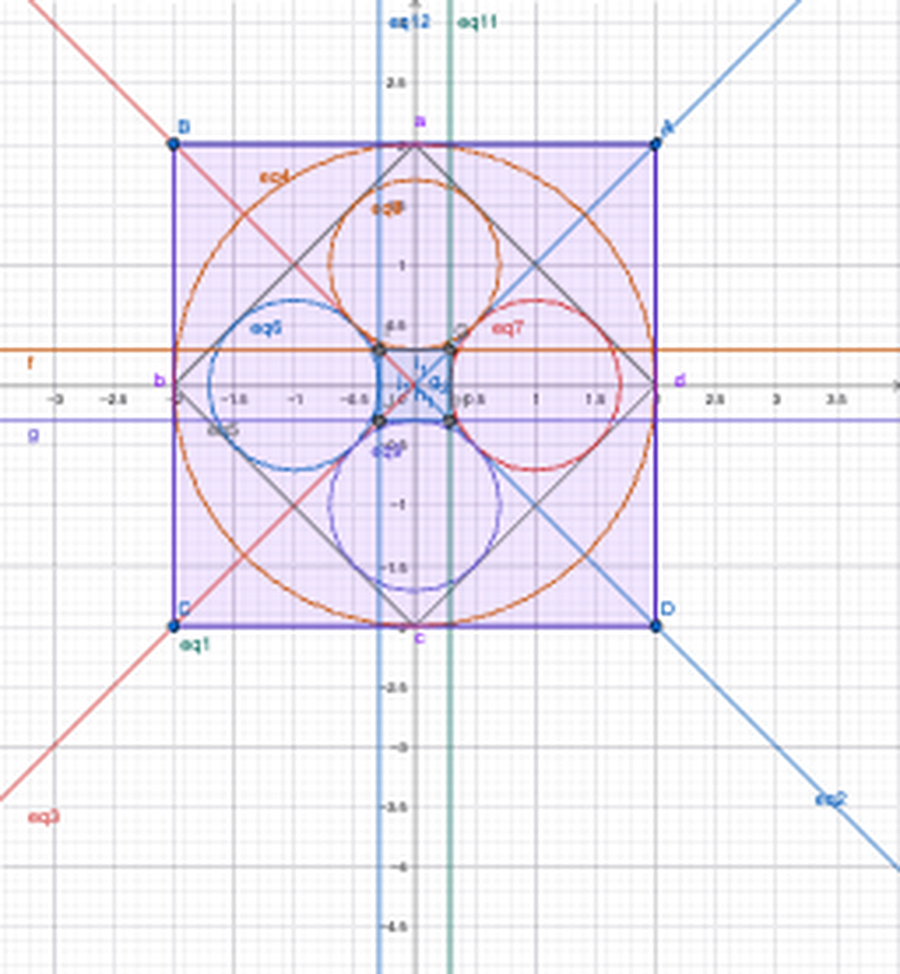
A compact symmetry study combining squares, diagonals, circles, and repeated contact relationships.
Open the live construction ↗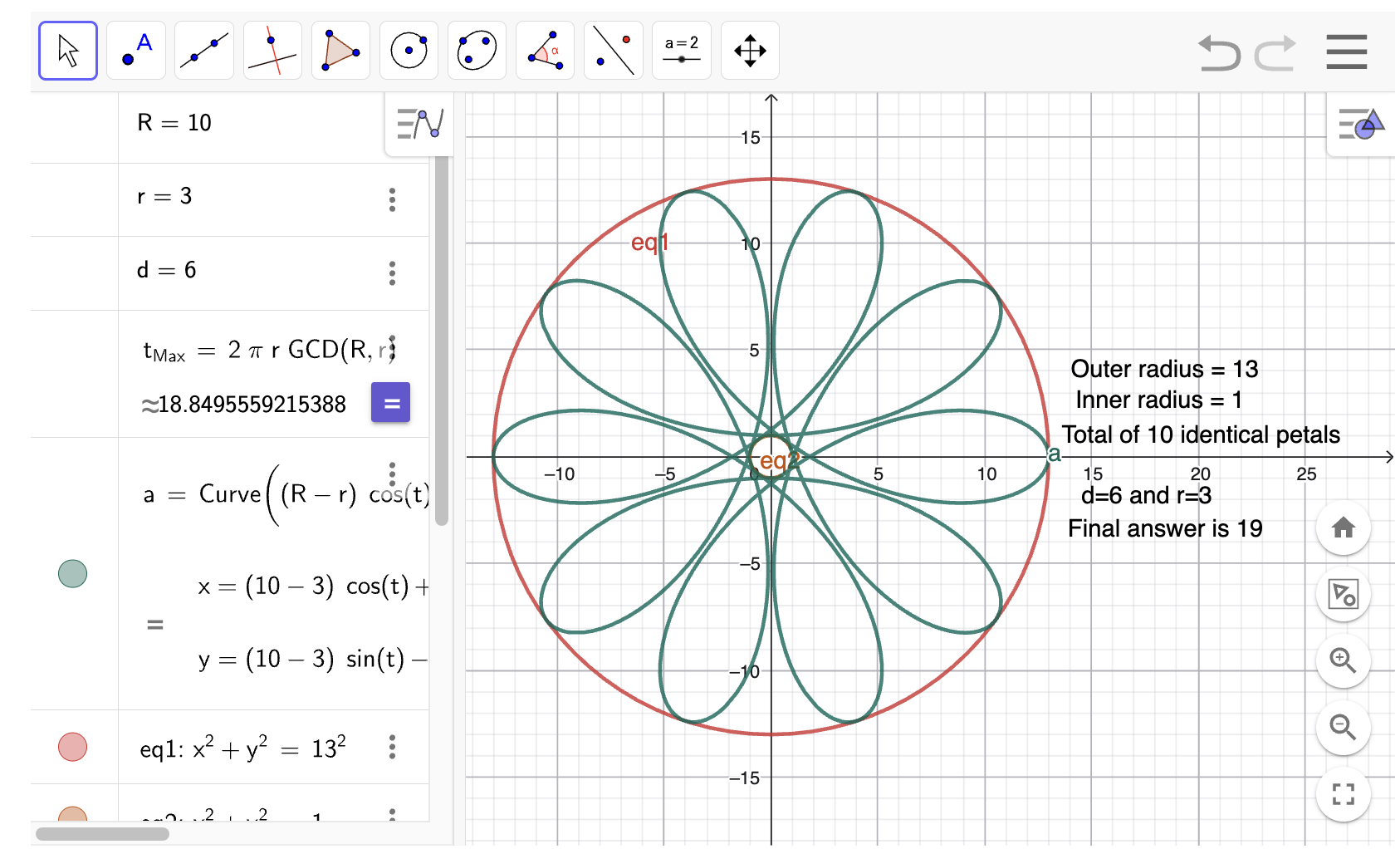
A parametric study of repetition, periodicity, and the relationship between inner and outer radii.
Open the live construction ↗GraphDat is currently centered on editable two-dimensional geometry. These independent 3D studies are a visual statement of intent: future experiments could introduce surfaces, depth, cameras, and spatial relationships without giving up structured scene truth.
A color-coded surface study built from stacked, rotating polygonal layers. Presented as a direction for future spatial tooling, not a current GraphDat output.
Open the live construction ↗Interlocking curved forms viewed through a moving camera. The study points toward scene-aware depth, surfaces, and 3D relationships.
Open the live construction ↗Two interpenetrating tetrahedra turn through several viewpoints, revealing the symmetry and spatial relationships inside the compound.
Open the live construction ↗A geometry-aware normalization layer cleans dictated input, and a fine-tuned FLAN-T5 model translates the request into a compact action-frame language. A deterministic scene engine validates references, assigns names, updates persistent state, and compiles the result into GeoGebra commands.
I started from Google’s 247.5-million-parameter model and trained it to translate natural language into compact geometry actions.
I curate and audit prompt-to-action records, then convert them into compact model-facing datasets.
Candidate examples must parse, execute through the scene engine, and produce the expected GeoGebra result.
The current recorded run separates equivalent outputs from genuine model mistakes instead of counting every wording difference as a failure.
Focused regression tests protect the model service, scene engine, API, data tools, and browser workflow.
Image Draw identifies silhouettes, internal boundaries, color regions, and visual details, then approximates them with editable polygon meshes. It is a separate, experimental branch of GraphDat rather than a capability of the language-to-geometry model.
A future tool-using copilot could query the actual scene for coordinates, distances, areas, dependencies, and relationships, then explain the result while the deterministic backend remains the source of truth.